Indian summers are no joke. Whether you are stepping out in peak afternoon heat or pushing through a long workday, the wrong fabric can make you miserable by mid-morning. But the right fabric changes everything. You stay cool, look put together, and move all day comfortably — just by making one smart choice at the fabric stage.
At Sara Fabrics, we work with boutique owners, tailors, and designers every day. Between March and July, the most common question we get is: Which fabric is best for summer kurtis? This guide answers that, covering only the fabrics we actually stock and sell.
What to Look for in a Summer Kurti Fabric
Before getting into specific fabrics, here is what actually matters for summer:
- Breathability — Can air move through the weave? This is what keeps your body temperature from rising throughout the day.
- Moisture absorption — Does the fabric pull sweat away from your skin? Natural fibres do this far better than synthetics.
- Weight — Lighter fabrics retain less heat. This is why voile and cambric are so popular in Indian summers.
- Softness — When you are hot and sweating, rough or stiff fabric becomes irritating fast. Soft, fine weaves are far more comfortable against the skin.
Natural fibres win on all four counts. Almost every top pick in this guide is a natural or natural-blend fabric.
Best Fabrics for Kurtis
1. Pure Cotton – The Best Fabric for Summer
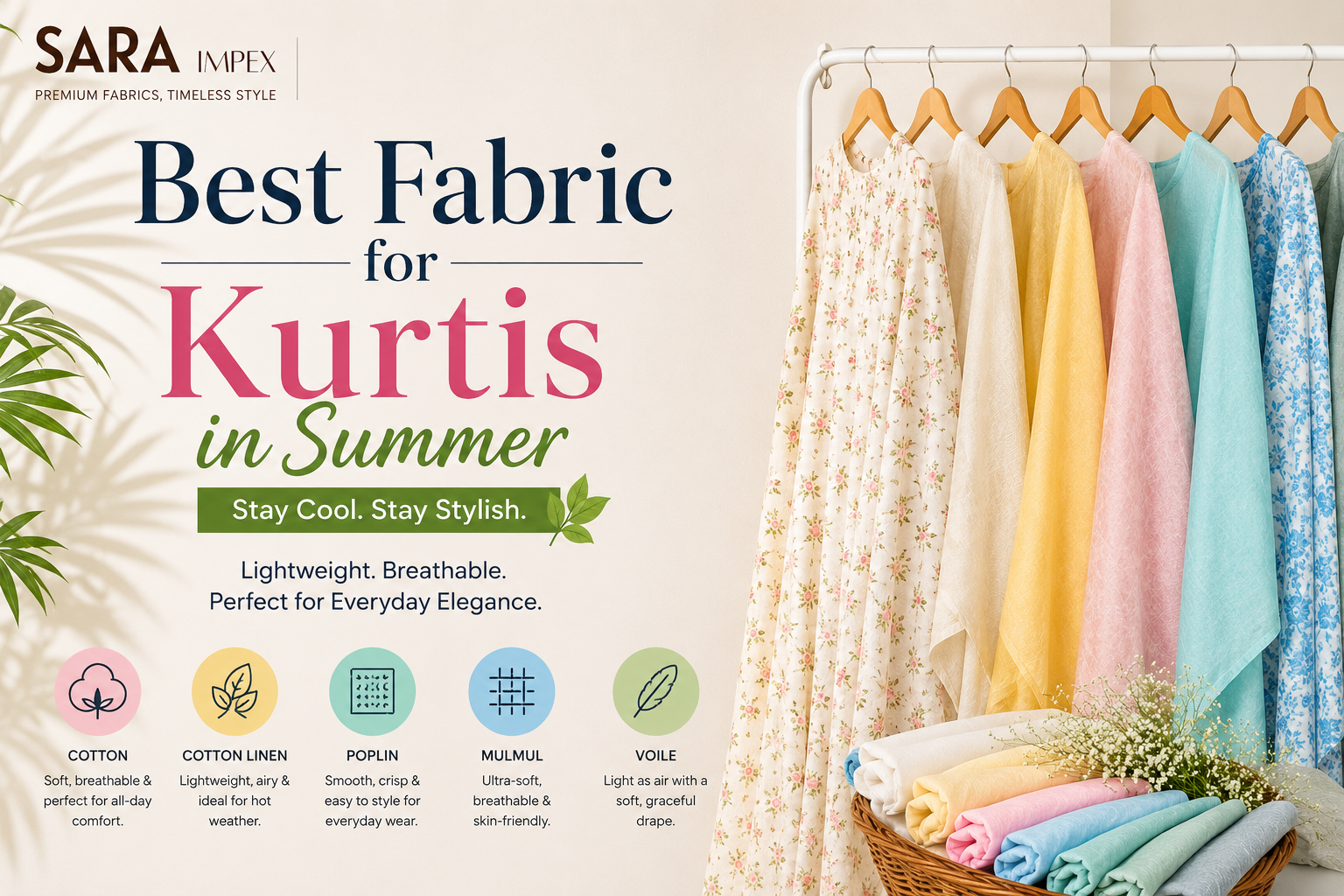
If you had to pick one fabric for summer kurtis, cotton wins every time. It is naturally breathable, highly absorbent, soft against the skin, and easy to wash and maintain. It does not hold odour the way synthetics do, which matters a great deal when you are wearing kurtis daily in the heat.
At Sara Fabrics, we carry a wide range of cotton fabrics suited for kurtis. Here are the cotton types most relevant for summer:
Cotton Poplin is one of the most widely used fabrics for summer kurtis. It has a fine ribbed texture, a smooth, polished surface, and a lightweight feel that breathes well while looking neat and structured. It works especially well for office-wear and smart-casual kurtis. Explore our cotton poplin collection, including the Cotton Poplin 60s and Paper Cotton Poplin 60s.
Giza Cotton is a long-staple premium variety that is noticeably softer and finer than regular cotton. It is ideal for kurtis that need to look polished while feeling exceptionally comfortable. The Indian summers are no joke. Whether you are stepping out in peak afternoon heat or pushing through a long workday, the wrong fabric can make you miserable by mid-morning. But the right fabric changes everything. You stay cool, look put together, and move all day comfortably — just by making one smart choice at the fabric stage.
At Sara Fabrics, we work with boutique owners, tailors, and designers every day. Between March and July, the most common question we get is: Which fabric is best for summer kurtis? This guide answers that, covering only the fabrics we actually stock and sell.
2. Cotton Linen – Breathable, Elegant, and Summer-Ready
Cotton linen blends the softness of cotton with the natural cooling properties of linen. Linen is one of the most breathable fibres available and is thermo-regulating by nature, meaning it helps your body stay cool rather than trapping heat. Blended with cotton, it becomes softer and more comfortable without losing its airy quality.
For summer kurtis, cotton linen sits at a sweet spot between comfort and refinement. It has a beautiful natural texture, drapes cleanly, and looks polished in structured silhouettes. This is why it has become a favourite for ethnic sets, formal kurtis, and Indo-western styles.
Browse our linen fabric collection for premium cotton linen options suited to kurti stitching. These fabrics are especially popular among boutique owners who want to offer something a step above standard cotton. Worth noting: cotton linen wrinkles more than poplin or cambric, but most people consider that part of its natural charm.
Best for: Ethnic sets, formal kurtis, Indo-western styles, designer boutique pieces.
3. Voile and Cambric – Ultralight Options for Flowy Kurtis
For maximum lightness, voile and cambric are the top picks. Both are cotton-based fabrics with a loose weave that makes them extremely airy.
Voile is semi-sheer and almost weightless. It has a fluid drape that works perfectly for anarkali kurtis, layered styles, and flared silhouettes. It takes printed patterns beautifully, which is why so many vibrant printed summer kurtis are made from voile.
Cambric is slightly more structured than voile, making it better suited for straight-cut everyday kurtis. It is smooth, fine, and comfortable without being too sheer or too heavy. It holds prints crisply and is one of the most popular bases for mass-market and boutique summer kurtis.
Browse our voile and cambric fabrics to find the right weight and weave for your designs.
Best for: Anarkali kurtis, printed summer kurtis, flared styles, and everyday casual wear.
4. Dobby Cotton – Woven Texture with Cotton Comfort
Dobby fabric features small geometric patterns woven into the cloth itself, creating a subtle textured surface without needing any prints or embroidery. It is a smart choice for boutique owners who want to offer something visually distinct.
Since dobby is cotton-based, it is breathable and comfortable. It is slightly heavier than cambric or voile, so it works better for cooler mornings, evenings, or air-conditioned indoor settings. For outdoor peak-summer wear, pair it with a lighter inner.
Explore our dobby fabrics for woven texture options that work well in summer kurta sets and Indo-western kurtis.
Best for: Boutique kurtis, designer ethnic wear, office kurtis in AC environments.
5. Cotton Gauze – Maximum Airflow for Peak Heat
Gauze is an open-weave cotton fabric designed for maximum ventilation. It is lightweight, soft, and has a relaxed, slightly textured appearance that suits casual and easy-going summer kurtis. It is particularly popular in regions with extreme dry heat, where airflow is the top priority.
Browse our gauze fabric collection for summer kurti stitching options.
Best for: Casual kurtis, relaxed summer styles, holiday and vacation wear.
6. Cotton Twill – Structured and Durable for Tailored Kurtis
Cotton twill has a smooth diagonal weave that gives it a clean, durable surface. While twill is heavier than poplin or cambric, finer count twill fabrics are comfortable in summer for structured kurtis and formal ethnic wear where shape retention matters.
Our Cotton Twill 30s and Cotton Fine Twill 40s are well-suited for tailored summer kurtis that need to hold structure throughout the day. Browse the full twill fabric range for all options.
Best for: Structured kurtis, formal ethnic wear, palazzo sets, tailored styles.
Fabrics to Avoid in Summer Kurtis
- Polyester traps heat and does not absorb moisture. Avoid it entirely for summer kurtis.
- Heavy synthetic blends create a barrier between your skin and the air, making them uncomfortable in heat, regardless of how they look.
- Non-cotton satin clings when wet and heats up quickly. Cotton satin is fine, but non-cotton varieties are not suited for daytime summer wear.
- Heavy brocade and jacquard are designed for winter and wedding wear. They are too thick and heavy for regular summer kurtis.
- The rule is simple: stick to natural fibres. Cotton, linen, and cotton blends will keep you comfortable no matter how hot it gets.
Matching Fabric to Occasion
- Daily wear and home kurtis: Pure cotton, cambric, or voile. Lightweight, easy to wash, and comfortable throughout the day.
- Office and corporate ethnic wear: Cotton poplin, Giza cotton, or cotton linen. These look neat, hold shape, and breathe well through long work hours.
- Casual outings and weekend wear: Dobby cotton or printed cambric. Comfortable and stylish without being overly formal.
- Festive and special occasion kurtis: Cotton, satin or Giza cotton. Elevated finish that still breathes well.
- Boutique and designer collections: Cotton linen, dobby, and Giza cotton offer a premium feel that justifies a higher price point.
- Bulk orders: Cotton poplin and cambric offer the best combination of comfort, printability, and value at scale.
Caring for Your Summer Kurti Fabrics
Wash cotton kurtis in cold or lukewarm water to prevent shrinkage and colour fade. Avoid wringing — gently press out excess water instead. Dry in shade rather than direct sunlight to protect prints and fibre strength. Cotton linen kurtis iron best when slightly damp. For printed voile or cambric, wash separately for the first few washes to avoid colour bleed. Store Kurtis folded rather than hung to keep the neckline and shoulder areas in shape.
Also Read
- Why Choose Cotton Linen as the Best Fabric for Summer
- The Complete Guide to Lightweight Fabrics for Everyday Wear
- Best Comfortable Fabrics for Women to Wear Daily
- Fabric Trends Every Boutique Owner Should Know in 2026
Frequently Asked Questions
What is the best fabric for kurtis in summer in India?
Pure cotton, especially 60s count, Giza cotton, or cotton poplin, is widely considered the best fabric for summer kurtis in India. Cotton linen is a strong second for structured and formal styles.
Which cotton is best for kurti stitching?
Cotton poplin (60s count) and Giza cotton are the top choices. Browse our cotton fabrics and poplin range for the full selection.
Is linen good for kurtis in summer?
Yes. Linen is thermo-regulating and highly breathable. Our linen fabric collection has options well-suited for summer kurti stitching.
Is voile good for summer kurtis?
Voile is one of the best options for flowy summer kurtis. It is ultralight and extremely breathable. Browse our voile and cambric range for printed summer kurti options.
Sara Fabrics stocks cotton, linen, poplin, voile, cambric, dobby, and gauze fabrics at wholesale prices with pan-India delivery. Browse the full fabric shop here.